Counterparty credit risk · Energy & commodity trading

A counterparty can be solvent through the cycle and still miss a margin call by nine o’clock.

Horizon is a specialist counterparty credit risk advisory for energy and commodity trading. We work with credit, risk and IT teams building, replacing or reviewing the models and systems behind their credit decisions.

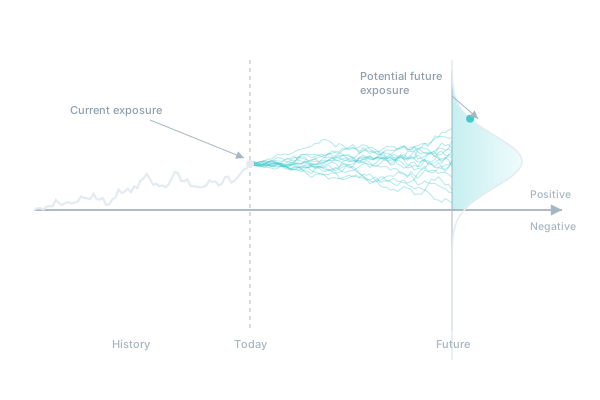
Potential future exposure fan chart — simulated exposure paths fan out from today to a future horizon, with the terminal exposure distribution and the potential-future-exposure quantile marked.
IndependentNo ratings and no platform to sell. The advice has no product sitting behind it.
SeniorThe people who scope the work do the work; no pyramid, no hand-off to juniors.
Global reachEngagements across Europe, from practice bases in London and Warsaw.
What we do

Three places we do our best work

Designed to fit the client’s book and governance, not a textbook template.

01

Methodology

Deterministic and simulated exposure (current and potential future exposure, pre-deal checking, stress simulation), plus collateral, margining and liquidity, with limit frameworks and credit policy, built around how the book actually trades.

02

Build support

Most in-house credit-tooling projects struggle at the interface between credit and IT. We formalise requirements, translate business logic into specification, and stay through design and testing so what gets built is what the business asked for.

03

Selection & assurance

Vendor-neutral system selection on signed-off weighted requirements, scripted demos and five-year total cost of ownership. Independent review of credit-risk models and implementations.

Credit risk, measured well, is an enabler

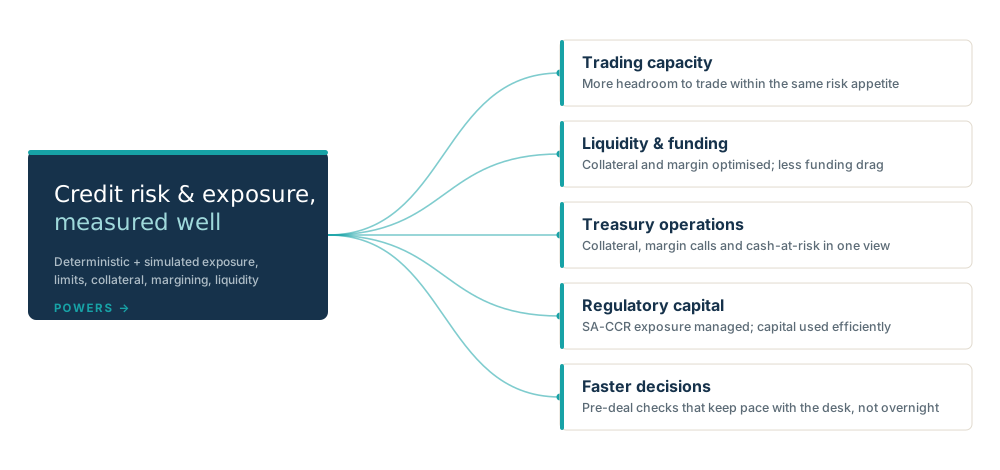
The same exposure engine that protects the firm expands what the desk can safely do, across trading, liquidity, treasury and capital.

Credit risk as an enabler — the exposure engine that protects the firm also expands what the desk can safely do across trading, liquidity, treasury and capital.
Counterparty Risk Notes · Independent research

The register of a research house, from a firm that sells no ratings

Issue 01 · Market-event note

When financialisation becomes counterparty risk

Ratings tell you whether a counterparty is likely to pay over the cycle. They are largely silent on whether your systems would see it fail to post collateral in time to act.

The build-out of commodity derivatives many times larger than the physical trade they reference has turned price volatility into an immediate funding and counterparty problem. Three stress tests in four years (2022’s margin shock, the LME nickel squeeze, and the 2026 Strait of Hormuz crisis) make the same point about exposure measurement, systems and data.

Three stress tests, one lesson

The mechanism is collateral, and it has been tested repeatedly.

€1.5tn+European margin calls estimated in the 2022 energy shock
≈$19.7bnLME nickel margin calls, dwarfing the $1.1bn default fund
$61→$120Brent’s 2026 round-trip as the Strait of Hormuz closed
Issue 02 · Methodology note

The unrated majority

A large share of energy and commodity trading counterparties carry no public rating to lean on. When the external signal is absent, the internal scorecard, the data feeding it and the governance around it become the entire line of sight, and each deserves the scrutiny a rating would have received.

Forthcoming
Issue 03 · Market-structure note

Wrong-way risk, when exposure and default share a driver

In power and gas, the price move that widens your exposure is often the same move that weakens the counterparty posting against it. We set out why potential future exposure measured in isolation understates the tail, and how to model that correlation without over-engineering it.

Forthcoming
Capability · The frontier of assurance

Agentic Assurance

Independent assurance of autonomous AI in counterparty credit risk.

The leading edge of the independent model and implementation review in our third practice, not a general AI-governance offering. Autonomous agents are now sold into credit functions to watch limits, exposure and counterparty news; they are non-deterministic systems, and conventional model risk assumes a stability they lack. Regulators have made governing them mandatory while declining to write the standard. We validate, assure and govern agentic systems used in credit so a CRO, internal audit and a regulator can rely on the output. A vendor cannot grade its own homework.

Request the working paper →
Why Horizon

A small senior team, deliberately

We stay narrow so we can be genuinely expert. Our work begins where a rating agency’s or a platform vendor’s ends, with the systems, data and governance that decide whether you see a problem in time to act.

Independent by design

No ratings and no platform to sell, so the advice has no product behind it.

Read our independence & conflicts policy →

Senior throughout

The people who scope the work do the work. No pyramid, no hand-off to juniors.

Fluent in both languages

We translate between the credit team and IT, the interface where most builds fail.

Evidence, not buzzwords

Every current-event claim carries a source. Developing events are flagged as provisional.

A one-page summary of the collateral mechanism behind the last three stress tests.

The team

Who you actually work with

Horizon is a partnership of senior credit-risk practitioners, independent, with no ratings, no platform and no vendor allegiance. Between them the team has delivered credit-risk transformation across the full path: scope, methodology, build and go-live.

Seamus Maher

Founder · Programme delivery

Seamus leads credit-risk transformations end to end. Over twenty-five years across energy, commodities and banking, he led the vendor-side global credit-risk rollout for BP on CubeLogic, built the CCAR revaluation at Citi, and delivered the market-risk scenario tool that became Barclays’ golden source for stress scenarios. He now directs a multi-year, regulator-facing credit-risk programme at a major European utility, coordinating a Beacon and Riskcubed stack across several vendors. There he surfaced counterparty exposure the firm had not previously seen and rebuilt the limit and breach-monitoring framework around it, retired two legacy systems, and replaced spreadsheet-based monitoring with automated exposure pipelines against an approved three-year business case. His platform experience spans Openlink Endur, Murex and Beacon as well as CubeLogic; his regulatory span runs from CCAR to today’s EMIR Refit, SA-CCR and Basel 3.1.

Michał Falkowski, PhD

Founder · Credit-risk methodology

Michał leads credit-risk methodology, with fifteen years in exposure and potential-future-exposure (PFE) analytics, pre-deal limits and price-curve stress testing across energy, commodity and financial markets. He is the practitioner who turns credit-risk requirements into the systems that enforce them: deterministic and simulated exposure, aggregation logic, counterparty hierarchies, collateral optimisation and margin workflows. On the current programme he owned the credit-risk specification end to end (exposure, limits, collateral, margining, liquidity, legal agreements and reporting), and carried the build from selection through to go-live, owning the business-IT interface throughout. At BP he scoped a deterministic credit-risk engine and defined the target-state PFE engine on Numerix, consolidating regional risk engines into one; at Anglo American he delivered a CubeLogic credit-risk engine and automated counterparty scoring and limit quantification. His doctoral research on the financialisation of commodities underpins our Counterparty Risk Notes.
Alexandra Dediu

Principal · Implementation & go-live

Alexandra leads implementation and go-live. Across her years at CubeLogic and as an independent consultant, she has taken credit-risk systems from first requirements into production for a range of energy and commodity firms: requirements analysis, configuration, data migration, testing and user training, end to end. On the current programme she leads the margining implementation, the system upgrades and the data integration around it, including the SAP feeds, and stood up the reporting and reconciliation that sits on top before training the desk that now runs it. She works the credit-to-IT interface from the technology side, translating exposure methodology into requirements a build can be held to, and the data quality that decides whether a limit breach is seen in time to act. A computer-science research background in simulation and optimisation sits behind the delivery.

Contact

Start a conversation

A short call to see whether the problem is one we can help with. If it isn’t, we’ll say so.

Email  contact@horizoncreditadvisory.com
Offices  London & Warsaw · Engagements across Europe

We read every enquiry ourselves and reply within two working days.

Your details go to the founders only, and we use them solely to reply to you. No newsletter, no third parties.